
Pen & Page Prompt #29
This Week: How returning is different from repeating

Pen & Page: What Comes Full Circle
A prompt about repetition, revisiting, and seeing familiar things differently.
Many of us think of progress as moving forward in a straight line. We imagine ourselves leaving things behind—old questions, old stories, old versions of ourselves—and continuing on toward something new.
Yet creative lives rarely work that way.
We return. To certain memories. To particular images. To places that continue to exert a quiet pull. We find ourselves writing about the same subjects years apart, only to discover that what has changed is not the subject itself, but our relationship to it.
When I first saw this week’s image, I wasn't thinking about amusement parks or summer afternoons. I was thinking about return. The Ferris wheel rises and falls, yet continually circles back to where it began. That movement felt familiar. So much of a writing life unfolds this way. We revisit old notebooks, recurring themes, unfinished questions, and memories we thought we had already explored. Yet each return offers a slightly different view.
Sometimes a return offers closure. Sometimes it reveals a new layer of understanding. Sometimes it simply reminds us that certain experiences remain part of the landscape we carry within us.
The Ferris wheel in this image suggests movement, but not movement in a straight line. It rises, descends, and circles back. The view changes with each turn, even as the path remains familiar.
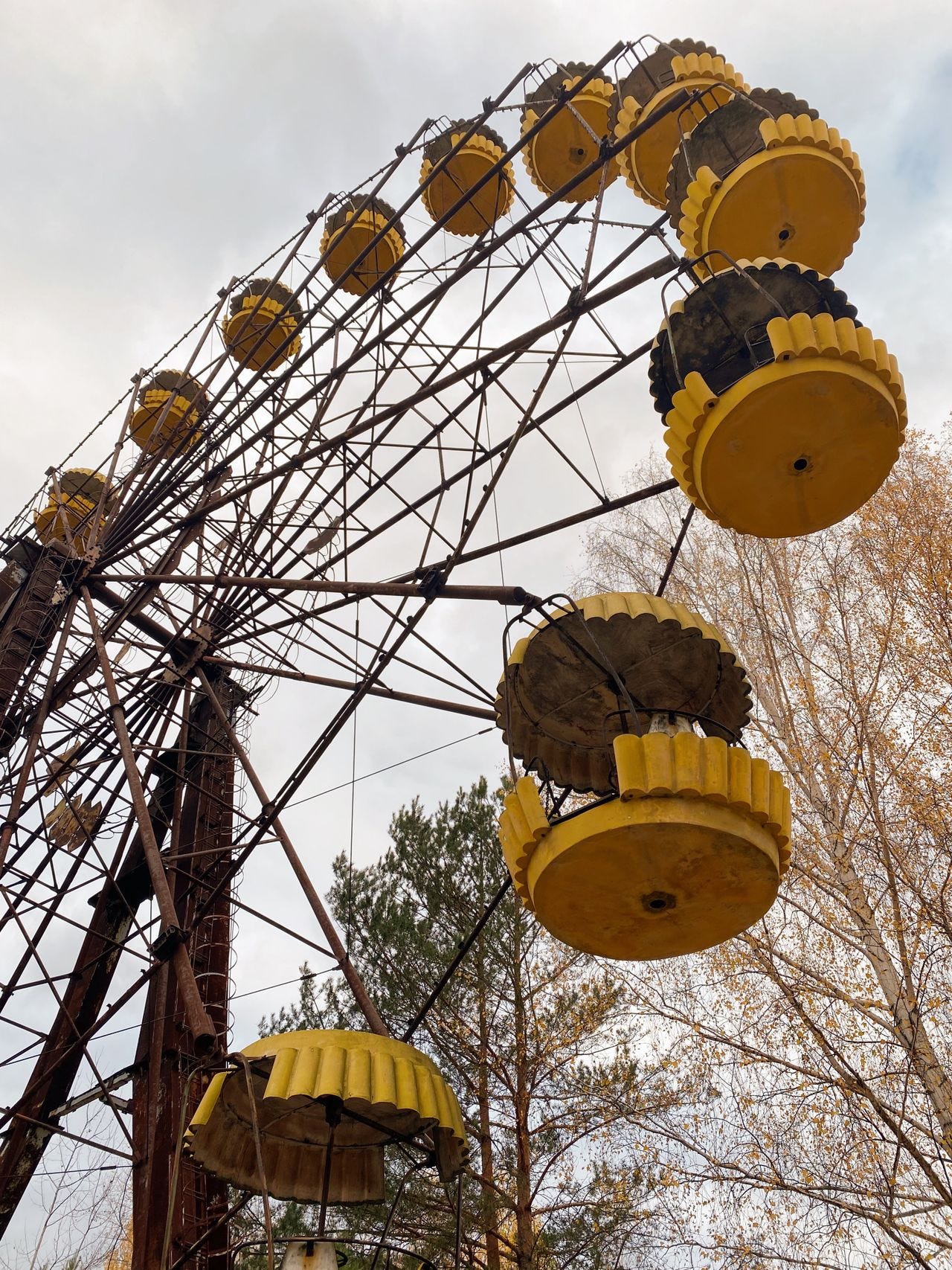
As writers, we often revisit the people, places, questions, and obsessions that continue to shape us. What once seemed resolved may ask for our attention again. What once felt ordinary may reveal something we had not yet noticed.
Today’s prompt invites you to return—to a memory, a place, a question, or a version of yourself—and see what appears when you look again.
Core Prompt
Write about something that has come full circle in your life.
It might be a place you have revisited, a relationship that has changed over time, a question that continues to return, or a memory that reveals something new each time you encounter it.
You might write from the perspective of your present self looking back, or allow the poem to move between then and now.
Consider what has changed, what has remained, and what can only be understood through the passage of time.
CRAFT MENU
Choose one or two approaches:
Use a recurring image that appears more than once in the poem.
Move between two time periods and allow them to speak to one another.
Begin and end with the same phrase, image, or setting, but let its meaning shift.
Explore a memory that looks different now than it once did.
Use circles, spirals, seasons, tides, or other cyclical patterns as an organizing structure.
Allow an old question to reappear and see whether the poem answers it—or leaves it open.
Constraints
Include the phrase: I thought I was finished with...
Let an object serve as a bridge between past and present.
Write the poem as a return to a place you have not visited in years.
Include a moment when your understanding changes.
Use repetition intentionally, allowing a word or phrase to gather meaning with each appearance.
Reflection
What in your life continues to call for your attention?
Are there subjects, memories, places, or questions you find yourself returning to again and again?
Sometimes repetition is not a sign that we are stuck. Sometimes it is an invitation to look more deeply.
What appears different when you return?
Share Back
If you’d like, share a favorite line, image, or discovery from your draft in the comments.
What surprised you when you returned to it?
An Invitation
If you’re looking for more sustained time with your writing, I hope you’ll consider joining River Heron Review this November for Retreat & Recharge: A Poet’s Getaway in the Pocono Mountains.
In addition to workshops, discussion, and dedicated writing time, every participant receives individualized feedback on their work. Writers may choose either a detailed review of two poems or a manuscript/chapbook overview designed to offer constructive, encouraging, and generative feedback.
This year’s retreat also includes an entire day devoted primarily to independent writing and creative exploration—time to follow a poem, return to a draft, and see where the work leads.


Here’s to many intriguing returns, surprises, and remaining open to what is offered for contemplation.
Write and thrive,
Robbin
10poetrynotebooks@gmail.com
robbinfarr.com
When I could stare at the ocean,
the water had no limits I could see.