
Another Angle: A Guided Poetry Exploration
How we discover the unexpected poem when we stop looking in familiar ways

#Margin Notes
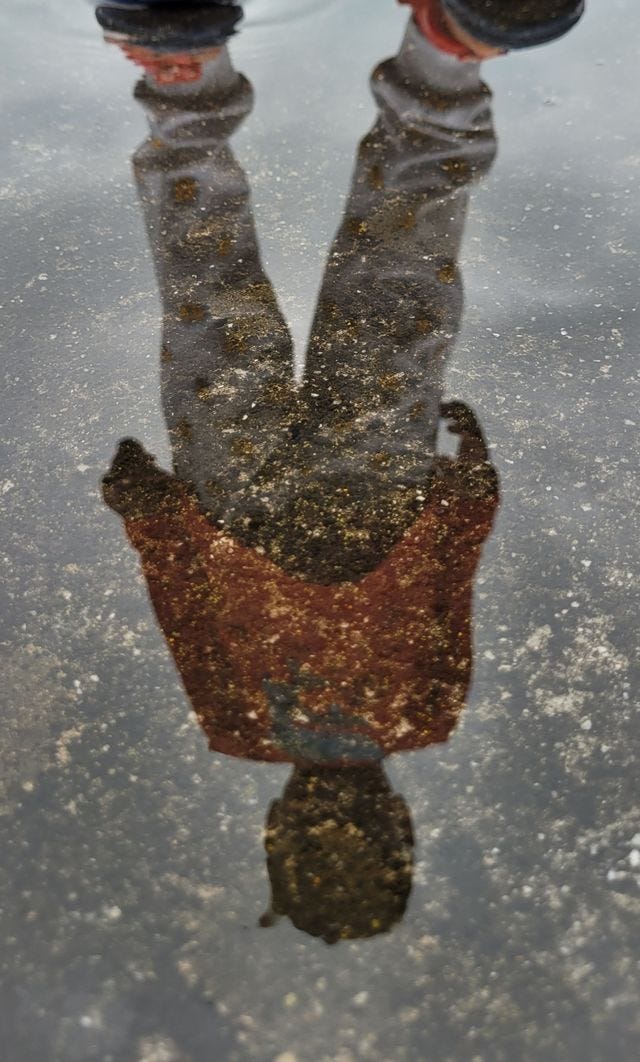
I almost passed by it.
The puddle was ordinary enough. Wet pavement. A child. A reflection.
Then I realized I wasn’t looking at the child at all. I was looking at light translated through water.
The reflection cannot tell us the child’s face with perfect accuracy. It blurs. It bends. It leaves things out.
Yet somehow it invites a richer kind of imagining.
Reflections don’t record.
They interpret.
I wonder if poems work this way.
We sometimes think our task is to reproduce experience exactly as it happened. But poems aren’t mirrors. They don’t reproduce a life. They refract it.
In that quiet transformation, something unexpected happens. The poem begins to reveal not simply what occurred, but what matters. It discovers emotional truth not by preserving every detail, but by allowing imagination to reshape experience into something another heart can recognize.
Perhaps that’s why the poems that stay with us rarely tell us precisely what happened.
Instead, they reveal something we couldn’t have seen by looking directly.
#Craft Notes
One of the most common misconceptions about writing from experience is that we must recreate events exactly as they happened. But poems rarely work that way. They don’t simply preserve experience—they transform it.
Think of memory as raw material rather than finished art.
Inside this Frame & Phrase post:
#Craft Notes on transformation
#Frame & Phrase Prompt on allowing the poem to become
Printable companion sheet
#On My Desk on Kelli Russell Agodon
Invitation to the River Heron fall retreat
